A Pilot's Guide to Inflight Icing
Module I - Before You Fly
Aircraft Design for Icing
Section: Deicing Systems
Start This SectionDeicing Systems Aircraft Design for Icing
Deicing systems are used to remove ice after it has accreted on the protected surface.
Although there are several methods available, the most common by far is the pneumatic leading edge boot. The boot inflates and breaks the adhesive bond between it and the ice. The ice is then carried away by the airflow. Depending on the aircraft, boots may protect the leading edges of wings, horizontal and vertical stabilizers.
In most installations, separate boot systems protect inboard, mid, and outboard sections of the wings and tailplanes. The different boots are timed to inflate sequentially when the system is activated. In standard boot systems, all tubes within a section inflate simultaneously.
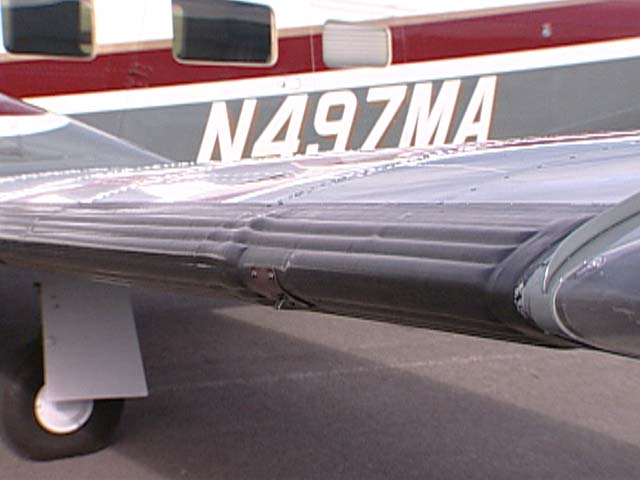
Expanded boots on wing

Residual ice on wing
Deicing Systems Aircraft Design for Icing
For many years, the flying community felt the proper way to operate a pneumatic boot was to wait for a significant amount of ice to form before inflating the boot.
Recent accident investigations suggest that this operational philosophy may have contributed to several fatal accidents. Waiting to inflate the boots can be dangerous. Ice accretion has caused roll upsets after less than 5 minutes of accretion.
Many aircraft and ice protection system manufacturers are now recommending that boot operation begin at the first indication of ice accretion. As always, be sure to review your AFM or POH to determine the specific operating requirements for your system.
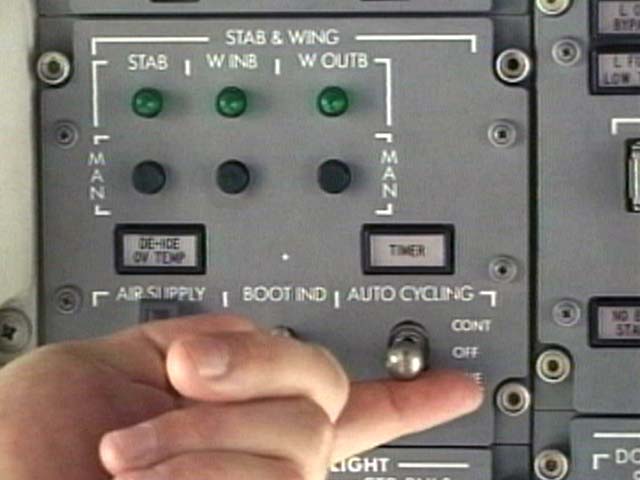
Auto-cycle activation

Wing boot close-up
Related Information
MONROE, MI
JANUARY 9, 1997
EMB-120
The aircraft was being vectored for an ILS approach to Detroit (DTW). The pilots slowed the aircraft to 150 knots while the aircraft leveled at 4,000 feet. While turning to the assigned heading the aircraft experienced an uncommanded roll and the autopilot disconnected.
Less than two seconds after the autopilot disconnected the flight data recorder indicated roll attitude increased from about 45 degrees left bank to about 140 degrees left bank and the pitch attitude decreased from nearly 2 degrees nose up to about 17 degrees nose down.
The control wheel position moved from about 18 degrees right to 19 degrees left. The aircraft struck the ground in a steep nose-down attitude about 19 nautical miles southwest of the airport.
Evidence indicates that the aircraft was picking up ice at a significant rate for less than a minute and the total accumulation was between 1/4 to 1/2 inch of ice.
Deicing Systems Aircraft Design for Icing
The old philosophy to wait for 1/4" - 1/2" of ice accretion was based on the belief that if the boots were activated too soon, the ice would not crack off and the boots would subsequently inflate and deflate beneath an ice "bridge" and be unable to remove it.
Ice bridging simply does not occur with modern boots.
FAA/BF Goodrich residual ice tests
Deicing Systems Aircraft Design for Icing
Recent wind tunnel and flight tests have studied boot cycles. They confirm that larger amounts of ice will shed more cleanly with one boot inflation than smaller amounts. However, the thicker ice causes greater performance degradation. Continuously cycling the boots inhibits the performance degradation and will control the ice accretion. One boot inflation cycle may not remove all ice, but subsequent cycles at short intervals will generally clean the leading edge, along with any newly accreted ice. Although ice may remain between cycles, the ice will ultimately clear as well as it would have if you had waited for a large buildup to activate the boots.
Warning
FAA/BF Goodrich residual ice tests
Related Information
Cycling the boots inhibits the performance degradation. A 4-minute deice cycle limits the overall drag increase and sheds the ice more completely each cycle. The drag is further reduced with a 1-minute deice cycle because the overall amount of intercycle ice is less than that at the end of a 4-minute cycle. Furthermore, even though a greater percentage of intercycle ice might remain between 1-minute cycles, the ice ultimately clears as well as it does for the longer cycle.

Brian Williams, Pilot
Deicing Systems Aircraft Design for Icing
NASA and several manufacturers have tested electro-mechanical deicing systems; similar systems were used in some Soviet aircraft. However, electro-expulsive deicing systems are just now coming into mainstream use.
In this system, coils of wire are supported within the skin of the protected area. A momentary high voltage current is sent through the coils. The resulting electromagnetic field causes the skin to deform very slightly but with great surface acceleration. This deflection is sufficient to crack the bond between the ice and the surface and allow aerodynamic forces to remove the ice.

Electro-expulsive deicing system schematic and test photo
Deicing Systems Aircraft Design for Icing
Pilot Action Recommendation
IF: You begin to accrete ice
ACTION: Activate the deicing system immediately and cycle continuously.* Do not wait for a certain amount of ice to accrete, unless the AFM directs otherwise.
CUES: Ice visible on the aircraft; ice detector activation; performance/handling anomalies.
WHY: By starting and continuing to operate the boots at the first indication of ice accretion, you can minimize the performance penalty and reduce the risk of a handling anomaly.
* If you have an automatic deicing system, select an appropriate cycle so that there is no appreciable buildup on the protected surfaces. If you have a manual system, deice at regular intervals so that there is no appreciable buildup.

Ice protection system panel