A Pilot's Guide to Inflight Icing
Module I - Before You Fly
Exercises
Section: Preflight Weather Planning Example
Start This SectionPreflight Weather Planning Example Exercises
Introduction
Preflight planning can be fast and efficient. In this example, the weather that contributed to an icing accident is examined to demonstrate how currently available weather products can be used to evaluate the icing potential along a route of flight and to plan alternative courses of action.
In this case, a pilot departed Patrick Henry Airport, Newport News, Virginia for Richmond International Airport (RIC), Richmond, Virginia. Had the pilot of this aircraft been able to conduct a preflight analysis of the weather using the approach described here, the outcome of this flight might have been different.
Preflight Weather Planning Example Exercises
NTSB Identification: NYC99LA073
Nonscheduled 14 CFR Part 135 operation of Air Taxi & Commuter RAM AIR FREIGHT (D.B.A. RAM AIR FREIGHT )
Accident occurred Tuesday, March 09, 1999 at RICHMOND, VA
Aircraft: Piper PA-32R-300, registration: N5454F
Injuries: 1 Uninjured.
The pilot departed in VMC conditions towards the destination airport. As the flight progressed, the cloud base began to lower and the visibility decreased. Unable to maintain VFR, the pilot obtained an IFR clearance and was told to climb to 2,000, then to 4,000 feet. While climbing from 2,000 feet to 4,000 feet, ice accumulation was noticed on the windshield of the airplane. Level at 4,000 feet, the ice accumulation continued, and the airplane descended back to 2,000 feet where ice no longer accumulated. On approach, as the airplane descended through a cloud layer about 500 feet from the ground, the ice began to shed from the airplane. Due to ice remaining on the windshield, the pilot had difficulty judging the distance to the runway and had to look through the side window of the airplane to maintain visual reference with the ground.
Preflight Weather Planning Example Exercises
NTSB Identification: NYC99LA073
The airplane touched down on the runway hard, and the main landing gear pushed up through the wings. Records revealed that the pilot did not obtain a weather briefing from FSS. An AIRMET was issued for light occasional moderate rime and mixed icing in clouds and precipitation below 22,000 feet along the pilot's route of flight.
The National Transportation Safety Board determines the probable cause(s) of this accident as follows:
The pilot's inadequate preflight planning/preparation which resulted in flight into icing weather conditions. A factor related to the accident was restricted visibility through the icy windshield during landing.
The kind of information this pilot would have found helpful can be found in the following sources: CIP, Area Forecasts, AIRMET ZULU, PIREPs, METARs and TAFs.
Let's look at the information he would have found in each one.
Preflight Weather Planning Example Exercises
CIP
CIP indicates a very high likelihood of icing along the entire route (see accompanying charts) with a high probability of SLD. Aircraft transiting the area above about 18000 would cruise in relative safety. However, climbing to that altitude would be impractical for the planned operation and in any case would require a considerable time spent in climb and approach in areas with a high probability of icing. Notice that CIP indicates that the probability of encountering SLD is lower at altitudes above about 5000 feet. CIP also indicates that the likelihood of encountering any ice is slightly lower between about 5000 and 7000 feet than it is a few thousand feet higher or lower. Of course, for an unprotected aircraft, the risk of flight in these conditions at any altitude would be too high using any reasonable criterion. However, in a protected aircraft, flight outside of SLD conditions would be possible and many aircraft were flying and reporting icing encounters.


Potential for icing at 3000 ft. (top chart) and 6000 ft. (lower chart)


Potential for SLD ice at 3000 ft. (top chart) and 6000 ft. (lower chart)
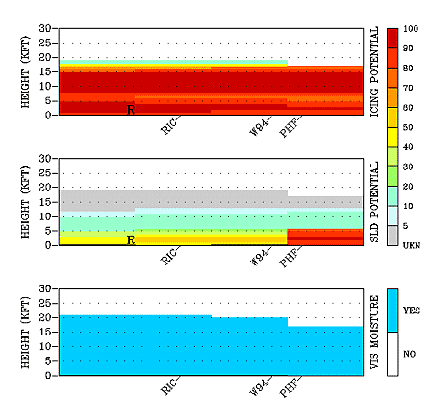
Vertical route display
Preflight Weather Planning Example Exercises
Area Forecast
At 1730 local, 1/2 hour prior to beginning the flight the Area Forecast synopsis for the Virginia area issued at 1345 stated that pilots should expect:
broken clouds at 1,000 feet, overcast clouds at 4,000 feet, visibility of 3 to 5 statute miles with light snow and mist, and occasional light freezing rain. The outlook was for IFR ceilings, snow and mist.
Preflight Weather Planning Example Exercises
Airmet ZULU
According to AIRMET ZULU:
AIRMET ICE...NY NJ PA OH LE WV MD VA DC DE AND CSTL WTRS
FROM YYZ TO HTO TO 100E ECG TO HMV TO HNN TO CVG TO FWA TO YYZ
LGT OCNL MOD RIME/MXD ICGICIP BLW FL220. FRQ MOD MXD ICGICIP SRN
OH WV AND WRN 1/2 MD AND WRN 2/3 VA. CONDS SPRDG EWD AND CONTG
BYD 03Z THRU 09Z.
FRZLVL...SFC-040 THRUT.
Based on the Area Forecast and AIRMET ZULU, there appears to be a relatively high probability of a serious icing encounter along the intended route of flight. Notice that the forecaster used the term "frequent" to describe the expected moderate mixed icing in this area (FRQ MOD MXD ICGICIP). The low freezing levels remove the possibility of descent out of icing should there be a serious encounter.
Preflight Weather Planning Example Exercises
PIREPs
ROA UA /OV ROA240020/TM 1855/FL040/TP CARJ/IC LGT RIME 100-040=
RIC UA /OV RIC040010/TM 1856/FL100/TP BE20/IC MDT RIME=
RIC UA /OV RIC245030/TM 1905/FL060/TP P34/IC LGT-MDT RIME=
SHD UA /OV MOL/TM 2209/FL350/TP UNKN/WV 275060=
RIC UA /OV RIC330015/TM 2223/FL030/TP MD80/IC MOD RIME 20-30=
RDU UA /OV 30N RDU/TM 1943/FL110/TP SF34/SK TOPS 105/IC TRACE RIME/RM FM APCH=
AVL UA /OV ODF040105/TM 1959/FL310/TP C650/TA -45/WV 288100/TB LGT CHOP=
GSO UA /OV LIB/TM 2000/FL100/TP DH8A/TA -03/IC MOD/RM IMC=
ILM UA /OV ILM/TM 2025/FL004/TP HS25/SK OVC004/RM ILS35=
RDU UA /OV RDU180010/TM 2028/FL070/TP JS32/TB MDT=
GSO UA /OV GSO/TM 2033/FL080/TP BE20/SK OVC018/TOPS 073=
CLT UA /OV CLT/TM 2025/FL080/TP B737/TB LT/MDT=
CLT UA /OV CLT045020/TM 2030/FL060/TP PA32/TA +6 e060/IC LGT CLR 015-030=
RDU UA /OV RDU090015/TM 2042/FL120/TP JS32/SK TOPS 120/IC LGT CLR 100-120=
GSO UA /OV LIB250040/TM 2122/FL050/TP PA27/TB LGT CHOP/IC LGT-MDT RIME SFC-030 LOST ICE ABOVE 30/RM DEPTG IPJ=
RDU UA /OV RDU145020/TM 2127/FL050/TP BE58/TA 05/TB MDT CHOP=
GSO UA /OV GSO180010/TM 2143/FL030/TP DC9/IC MDT/RM DID NOT SPECIFY TYP IC=
RDU UA /OV RDU230005/TM 2135/FLDURD/TP B767/TA 3000FT +10, 1000FT 0/WV 3000FT 050040, 1000FT 157022=
RDU UA /OV RDU/TM 2145/FLDURD/TP F100/TA 3000FT +6 1500FT -1/WV 3000FT 240035 1500FT 140025=
GSO UA /OV GSO18040/TM 2212/FL090/TP C500/SK TOPS 080/BL/E120 OVC/TA M04/WV 260032/TB LGT=
Preflight Weather Planning Example Exercises
METARs
The METARs and TAFs for this period on and close to the intended route of flight likewise suggest freezing levels and clouds or precipitation at or near the surface. ORF reported ice pellets within the hour and several stations are forecasting snow and/or ice pellets during the planned time of the flight.
| STN | TIME | VIS | ALTMR | TMP | DEW | DIR | SPD | WEATHER | CLOUDS | REMARKS |
|---|---|---|---|---|---|---|---|---|---|---|
| KFKN | 2201 | 4 | 30.02 | 3 | 1 | 100 | 4 | OVC031 | ||
| KFKN | 2218 | 3 | 30.02 | 3 | 1 | 060 | 4 | BKN017 OVC027 | ||
| KFKN | 2238 | 5 | 30.00 | 3 | -2 | 100 | 5 | BKN019 OVC027 | ||
| KORF | 2151 | 7 | 30.04 | 2 | 1 | 130 | 5 | -RA SN | FEW019 SCT025 OVC040 | AO2 RAB13SNB2054 |
| KORF | 2212 | 10 | 30.03 | 2 | 1 | 140 | 7 | -RA | FEW019 BKN036 | AO2 SNE02PLE12 |
| KPHF | 2147 | 7 | 30.08 | 2 | 0 | 090 | 8 | -RA | SCT009 OVC017 CIG 014V021 | |
| KRIC | 2054 | 9 | 30.07 | -1 | -3 | 070 | 4 | OVC012 | AO2 SNB32E42 |
Preflight Weather Planning Example Exercises
TAFs
KRIC 092149Z 092218 08005KT P6SM SCT010 OVC030
TEMPO 2224 5SM -SNPL OVC010
BECMG 0103 03010KT 5SM BR OVC012 PROB40 0309 3SM -SNPL BKN005
FM0900 36010KT P6SM OVC020
BECMG 1517 BKN030=
KORF 092156Z 092218 11008KT P6SM SCT015 OVC040
TEMPO 2202 3SM -RASN OVC015
BECMG 0204 02010KT 5SM BR OVC015 PROB40 0410 3SM -SNRA BKN006
FM1000 36014KT P6SM OVC020
BECMG 1517 BKN030=
KPHF 092159Z 092218 10010KT P6SM SCT008 OVC025
TEMPO 2202 3SM -SNRA OVC008
BECMG 0204 02010KT 5SM BR OVC015 PROB40 0410 3SM -SNRA BKN006
FM1000 36014KT P6SM OVC020
BECMG 1517 BKN030=
Preflight Weather Planning Example Exercises
Concluding Remarks
Clearly, flight in these conditions in an unprotected aircraft would be hazardous. To minimize the risks of flight in these conditions in protected aircraft, the preferred option would be flight at or above FL180. If this were impractical, the risks would be lessened by flying above 5000 feet where the chance of encountering SLD is diminished. Between about 5000 and 7000 feet the risk of an icing encounter is also somewhat lessened, though the chance of encountering ice at these altitudes remains quite high.
For many flights in this area, it would also be possible to circumvent the areas of greatest risk. The horizontal CIP plot shows many areas in the vicinity where the probability of an icing encounter is relatively low. For example, it would be possible to travel from the extreme southern portion of North Carolina to the northern border of Virginia at 6000 feet in airspace that had very low probability of icing by flying along a route roughly due north of Durham.