A Pilot's Guide to Inflight Icing
Module II - In the Airplane
Section: Module Overview
Start This SectionModule Overview In the Airplane
Good pre-flight planning can reduce the risk of a serious icing encounter, but no amount of planning will enable you to determine precisely when and where you will pick up ice. Not only are icing forecasts imperfect, but unexpected events may occur. For example, you may have an equipment failure, or be placed in an extended hold in icing conditions.
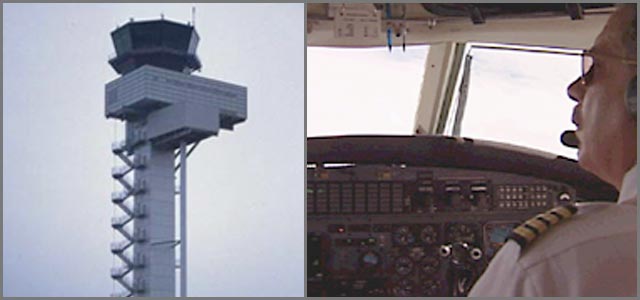
Left: Control Tower, Right: Pilot during flight
Navigation Hint: Use your "page up" and "page down" keys to navigate between section pages.
Use your "left" or "right" arrow keys to navigate between sections.
Module Overview In the Airplane
You may encounter ice during any phase of flight. To fly safely in icing conditions, you must be able to assess the situation in flight and take appropriate action. You need to monitor the weather and the performance of your aircraft. You need to have an exit plan; you need to update that plan throughout the flight; and you must also be prepared to carry out that plan, even if it means diverting to an alternate or declaring an emergency.
In this module, we discuss cues that you can use in flight to assess the icing risk and steps that you can take during each phase of flight to reduce that risk.

Left: Ground de-icing, Right: rosemount ice detector