A Pilot's Guide to Inflight Icing
Module II - In the Airplane
Flight Operations
Section: Ground Operations
Start This SectionGround Operations Flight Operations
Taxi and take-off in icing conditions present several unique hazards.
Of course, ramps, taxiways, and runways covered with ice, snow, or slush will cause traction problems, as well as possible adhesion of ice and slush to critical airplane surfaces due to splashing. Not so obvious is how handling may be affected by deicing fluids. In this section, we discuss the specific issues associated with ground operations in icing conditions.
Taxiing
Ground Deicing
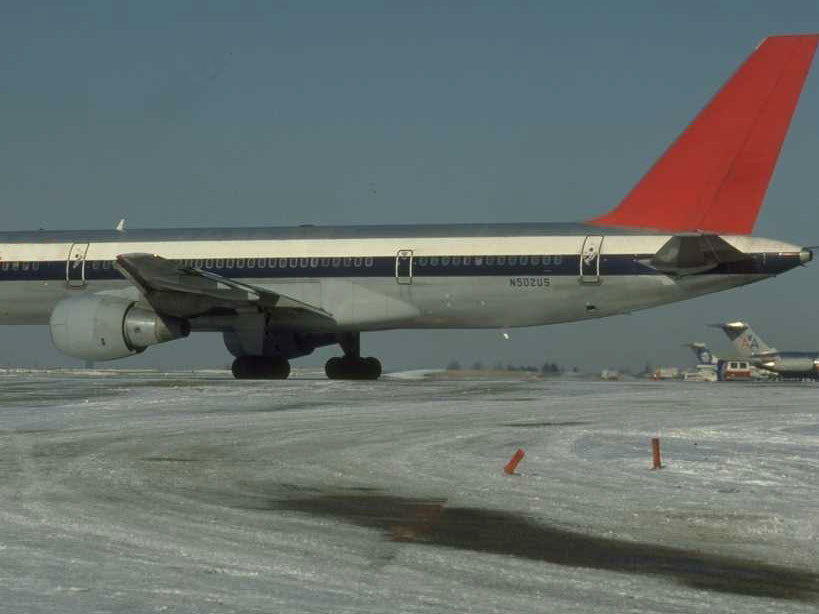

Ground operations
Ground Operations Flight Operations
Taxiing in snow, slush, or ice presents several hazards. Traction, braking, and directional control are reduced.
To decrease the risk of collisions, avoid high power settings and increase power slowly. Taxi slowly and stay farther away from other aircraft.
To prevent slush from contaminating control surfaces, taxi at low speeds and steer clear of prop and jet wash that can blow slush onto control surfaces. If this slush is not cleared prior to take-off, it may freeze in flight.

Aircraft taxiing in snow
Ground Operations Flight Operations
Watch for snow banks; snow piled alongside taxiways may present a collision hazard.
Watch for obscured surface markings; snow and slush can obscure pavement markings and create a runway incursion hazard or cause you to taxi off the taxiway and onto a soft embankment.
If you become uncertain of your position, stop and ask ground control for assistance.

Snow and slush can obscure pavement markings
Ground Operations Flight Operations
If frozen contaminants are present on the aircraft's critical surfaces they must be deiced and anti-iced (as appropriate) on the ground prior to take-off.
Warning
No aircraft should attempt to take off with frost, snow, or ice adhering to wings, propellers, control surfaces, engine inlets, or other critical surfaces. This is a critical safety issue and a legal requirement. Contamination as small as 80-grit sandpaper can cause a 25% loss of wing lift. You may be able to lift off the runway in ground effect but be unable to climb.

Ground deicing in winter
Ground Operations Flight Operations
Well-developed ground deicing/anti-icing methodologies and procedures have been established for the airlines. Adherence to these procedures has led to an accident free record for large aircraft commercial operations since the early 1990s.
For general aviation, however, insufficient or improper ground deicing/anti-icing continues to cause several fatalities a year. Even though FBO personnel may deice your aircraft, you are ultimately responsible for ensuring that it was done appropriately.
Ground deicing is typically accomplished in several ways. The aircraft may be treated with deicing/anti-icing fluids, placed in a heated hangar then sprayed with anti-icing fluid, or deiced via mechanical means with brooms, rubber scrapers, or forced air.
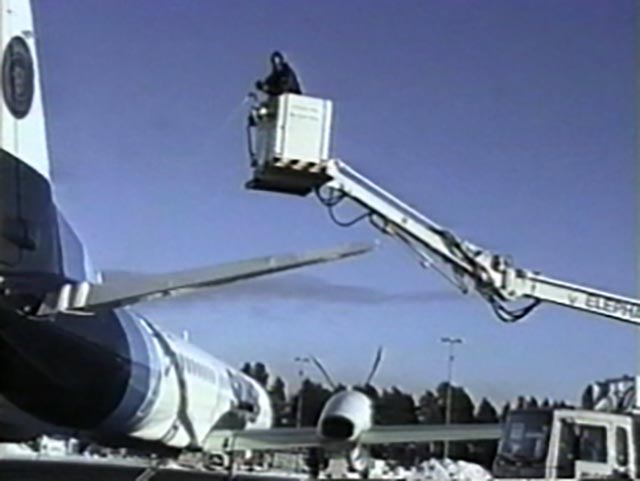
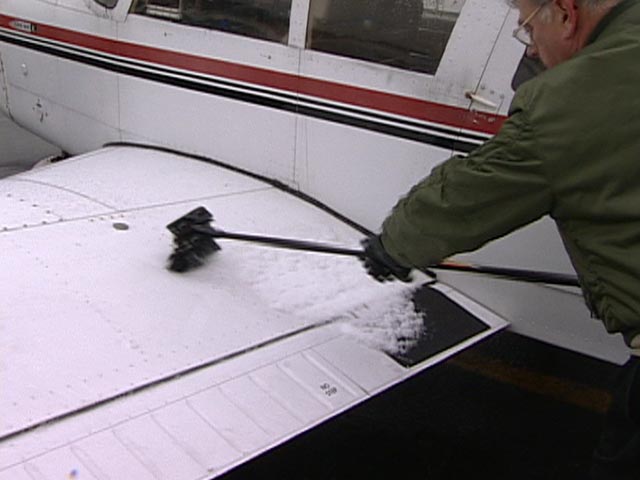
Large transport vs. small aircraft operations
Ground Operations Flight Operations
There are four types of deicing fluids. A primary distinguishing feature is their viscosity, which impacts both the holdover time and rotation speed. The more viscous (thicker) the fluid, the longer the holdover time, but the higher the rotation speed required. The deicing fluids and some of their characteristics are identified in the chart and the "Related Information" links on this page.

Deicing Fluid Chart (View Enlargement)
Related Information
Type I fluids have a high glycol content and a low viscosity; however, they are always applied diluted and heated. When applied hot, these fluids exhibit good deicing properties but provide very limited protection against refreezing in precipitation.
Type I fluids may be applied to any aircraft when the anticipated time between deicing and take-off is minimal.
Type II fluids have a higher viscosity than Type I fluids due to the addition of thickening agents. These agents enable Type II fluids to remain on the aircraft surface during standing, taxi, and other low speed operations and to rapidly flow off due to wind shearing forces during take-off roll. These fluids provide better protection against refreezing than Type I fluids. For anti-icing applications, this fluid may be applied undiluted.
Type II fluids are designed for use on an aircraft with take-off rotation speeds of 100 to 110 knots or more and may be applied when substantial time is anticipated between deicing and take-off.
Type III fluids have a viscosity higher than Type I fluids but much lower than Type II or IV fluids. For anti-icing applications, this fluid is applied undiluted.
Type III fluids were formulated for use on small commuter-type aircraft with take-off rotation speeds that exceed approximately 60 knots.
Type IV fluids offer the best protection against refreezing.
Type IV fluids are designed for aircraft with take-off rotation speeds of 100-110 knots or more, and may be applied when substantial time is anticipated between deicing and take-off.
Ground Operations Flight Operations
The SAE in conjunction with the FAA, Transport Canada, airlines, aircraft manufacturers, and producers of deicing fluids develop and publish specific procedures for aircraft ground deicing. Consult the procedures applicable to your aircraft and operation.
The FAA and Transport Canada publish holdover time guidelines which are the times aircraft surfaces can be expected to remain protected from refreezing after anti-icing. These guidelines are provided for conditions of active frost, freezing fog, freezing drizzle, light freezing rain, and rain on cold soaked wings.

Ground deicing operations
Ground Operations Flight Operations
Whereas the airlines follow mandated processes for deicing aircraft, general aviation operations tend to have less rigor or support. Deicing guidelines can be found in the FSAT, under "FAA Approved Deicing Program", and from the fluid manufacturer. Briefly, the best practices for deicing small general aviation aircraft include:
- Spray the aircraft with Type I fluid that is diluted and heated to nominally 60°C (140°F) at the nozzle.
- Spray the aircraft with heated water if the temperature is -3°C (27°F) or warmer, immediately followed by a second anti-icing treatment of heated Type I fluid heated to nominally 60°C (140°F) at the nozzle.
- Place the aircraft in a heated hangar to melt frozen contaminants, followed by anti-icing to prevent refreezing of the melted contaminants when the aircraft is removed from the hangar.
- Use mechanical means, such as brooms, rubber scrapers, or forced air.

Ground deicing at night
Ground Operations Flight Operations
All deicing/anti-icing fluids are designed to shear off during the take-off roll and do not provide protection after take-off. Nevertheless, because of their high viscosity, Type II, III, & IV fluids may continue to adhere to some parts of the aircraft during rotation and take-off. This could affect the handling qualities of your aircraft. Whenever these thickened fluids are applied, be sure to follow the manufacturer's recommended procedures for your aircraft, including procedures for operation of the engines and auxiliary power unit.
Warning
Small general aviation aircraft should never use thickened fluids - especially Type II & IV but also Type III in most cases - because their rotation speeds are not high enough to completely shear the fluid off the wing. Only use Type II, III, & IV fluids with the approval of the aircraft manufacturer.
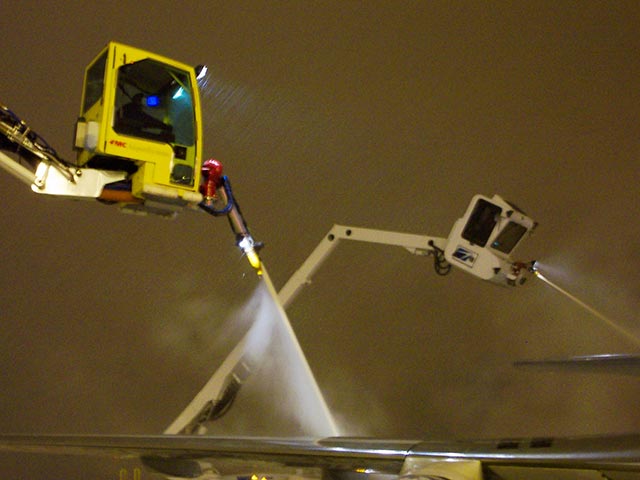
Ground deicing at night
Ground Operations Flight Operations
Pilot Action Recommendation
IF: You detect ice on your aircraft during the preflight inspection.
ACTION: Ensure that all critical aircraft surfaces are completely clear of snow, ice and other frozen contaminants. Always check for full movement of the controls after deicing.
WHY: Mixtures of water, slush and deicing fluid may accumulate in aerodynamically quiet areas such as gaps surrounding control surfaces or in the landing gear. These accumulations may refreeze after take-off and impede control or gear movements later.
Keep a constant vigil on the state of your anti-icing protection during ground operations in active freezing precipitation. Always conduct a pre-takeoff check for frozen contaminants just prior to take-off.
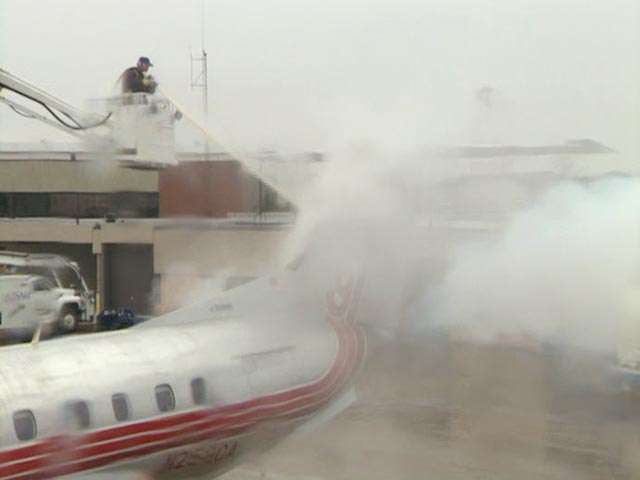
Ground deicing operations