A Pilot's Guide to Inflight Icing
Module II - In the Airplane
Flight Operations
Section: Arrival - Act
Start This SectionArrival - Act Flight Operations
If icing is expected during the descent or approach, and you have determined that it is not expected to be hazardous, attempt to minimize your exposure during each part of the arrival:
Holding
Approach
Missed Approach
Landing

Descent through clouds
Arrival - Act Flight Operations
Holding
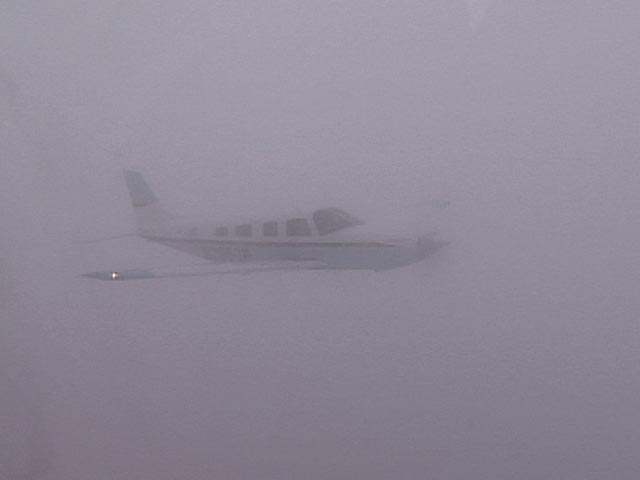
Holding in icing can be a very hazardous maneuver. Flying a holding pattern keeps the airplane in a small area for a prolonged period. Although the lateral extent of an icing region may be quite limited, if an aircraft remains in the area for an extended period of time, it can pick up considerable amounts of ice. Furthermore, holding airspeeds may conflict with the manufacturer's minimum icing speeds.
Don't accept an extended hold in icing. If you hold in icing conditions, closely monitor the aircraft's performance and handling and keep the speed up. If substantial amounts of ice begin to accrete on the aircraft, request a different altitude and/or fix if you are not cleared for the approach. If serious icing is encountered, take immediate action to leave the hold.

Holding in icing can be very hazardous
Related Information
ROSELAWN, IN
OCTOBER 31, 1994
ATR-72
The aircraft was on a flight from Indianapolis to Chicago (ORD) in a holding pattern at 10,000 feet. The flaps were extended to 15 degrees. The aircraft was in the hold for approximately 32 minutes when it was cleared to descend to 8,000 feet. As the flaps were retracted and the aircraft descended through 9,130 feet, the angle of attack increased beyond 5º nose up. The ailerons rapidly deflected and the autopilot disconnected. The airplane rolled rapidly to the right. The aircraft was in a full right wing down position only 1/2 of a second after the autopilot disconnected. Following several unsuccessful attempts by the crew to correct the airplane's attitude, the aircraft impacted a soybean field.
According to the NTSB, the encounter with icing conditions in the hold resulted in a ridge of ice accreting aft of the wing deicing boots and in front of the aircraft's unpowered ailerons.
Ellen Tom, FAA Research Pilot
Arrival - Act Flight Operations
Holding
Consult the AFM for any specific procedures for holding in icing. Unless otherwise specified in the AFM, hold with the flaps retracted.
Warning
Be careful of the autopilot "altitude hold" setting. If there is ice on the airframe, the autopilot may increase the angle of attack to correct for the tendency to descend. Because ice accretion increases the stall speed, this may lead to an unexpected wing stall.
Holding in icing can be very hazardous
Arrival - Act Flight Operations
Approach
Keep your speed up on the approach. This will minimize the risk of a wing stall.
Consider limiting or delaying flap extension. This will reduce your drag and minimize the risk of a tail stall. Be sure to check your AFM for the proper procedure.
If there is suspected icing below, stay on top of the clouds for as long as possible and ask for variances in the normal vectoring altitudes. However, beware of "slam dunk" approaches. Be sure to maintain appropriate descent rates. A rapid control change in an ice-contaminated aircraft could lead to wing or tail stall.
Also, beware of prolonged approach vectors that can keep you in icing.


Keep your speed up to prevent wing stall. Stay on top of suspected icing for as long as possible
Related Information
Brian Williams, Pilot
Kurt Blankenship, NASA Research Pilot
Mike Monreal, Former ATR-42 Pilot
Arrival - Act Flight Operations
Missed Approach
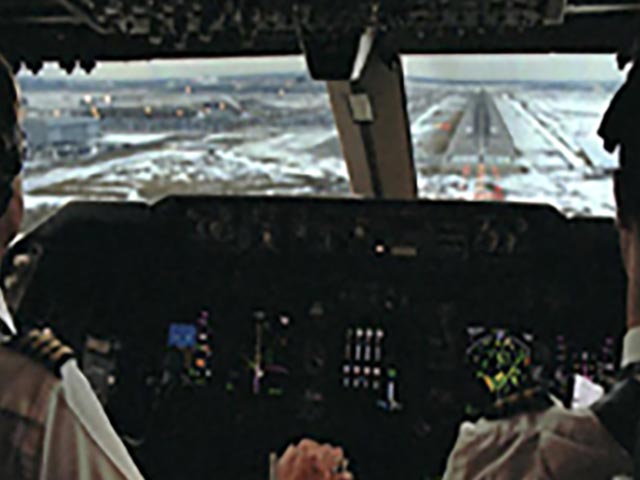
Flying a missed approach with a contaminated airfoil can be extremely hazardous. The transition from approach to climb, when performed at approach minimums, needs to be very smooth with careful attention paid to the airspeed. Missed approach procedures require that the aircraft engage in high performance maneuvers close to the ground. With ice accretion, some aircraft may not be able to safely execute some missed approach procedures. Even high performance aircraft may not be able to execute a single-engine missed approach with ice on the airfoils.
Do not start an approach if the local weather conditions are such that a missed approach may be necessary (e.g., due to fog, low ceilings) and the accretion of ice on the aircraft suggests that you many not be able to successfully complete the missed approach. Diversion to your alternate may be the best option.

Flying a missed approach with a contaminated airfoil can be extremely hazardous
Arrival - Act Flight Operations
Missed Approach
If you miss an approach with ice on the aircraft, you must decide whether to attempt another approach or divert to your alternate. Icing conditions and aircraft performance must be considered in making this decision. Ice accretion will decrease performance and airspeed and increase fuel burn, making it more difficult to reach your alternate. However, if you attempt a second approach, be very careful; a second missed approach would likely add more ice accumulation.
Flying a missed approach with a contaminated airfoil can be extremely hazardous
Arrival - Act Flight Operations
Landing
Remember that the runway may be wet or iced. Even if the runway is long enough for a landing at above normal landing speeds when dry it may not be long enough for a safe landing when wet or covered with snow or ice.
Rejected landings, or go-arounds, with ice contaminated airfoils are extremely hazardous. These maneuvers require that the aircraft engage in a high performance maneuver very close to the ground, often beginning with very low energy (low power, unspooled engines, low airspeed).
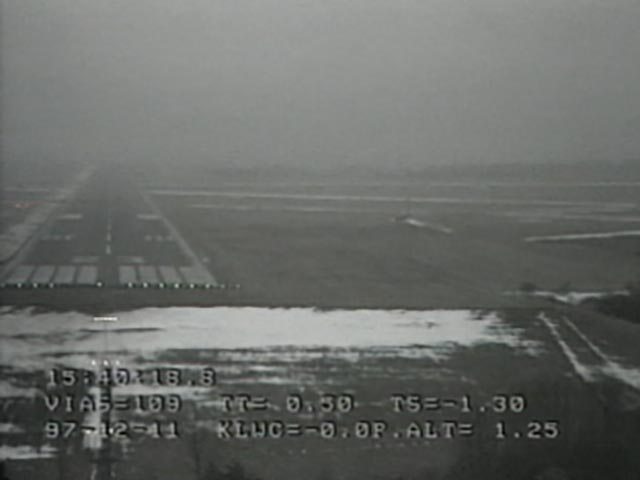
Flight deck view of runway on approach
Arrival - Act Flight Operations
Landing
If the runway is reported to be contaminated, check the AFM for adjusted landing distances and speeds. Remember that with a contaminated wing or tail you may need to keep your speed up or land with partial flaps to reduce the possibility of a wing or tail stall. If, because of the runway conditions and/or length, a safe landing at the intended destination cannot be assured, consider diverting to your alternate. If you must land on a contaminated runway with an iced airfoil, decide whether you will risk a go-around or a ground loop before beginning your approach.
Flight deck view of runway on approach
Arrival - Act Flight Operations
If you are picking up ice, be proactive and request a different altitude or fix. Be sure to clearly communicate your need to exit the icing conditions to ATC.
In a crowded terminal area, the radio chatter and traffic may be intense. Be prepared to interrupt on-going communications and to declare an emergency if necessary. If communication cannot be established, and use of emergency authority is required, consider squawking 7700.
Do not loiter in serious icing conditions.

Clearly communicate your needs to ATC
Related Information
Audio example to request to ATC
Pilot: "Center, this is NASA 616. I'm going to have to declare an emergency if I don't get a descent immediately."
ATC: "NASA 616, turn right heading 320. Descend and maintain 6000."