A Pilot's Guide to Ground Icing
Module I - Risks
Exercises
Section: Situated Questions
Start This SectionSituated Questions Risks
Question 1
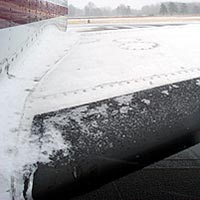
During the preflight, you discover a thin coating of frost about the roughness of medium sandpaper only on the outboard section of the pilot’s side wing. If you had missed this contamination and had attempted to take off, the aircraft would have probably:
Situated Questions Risks
Question 2
You are the Captain of a light jet flying with a new FO. After completing his preflight inspection, the FO joins you in the cockpit and announces that the aircraft looks clean except for some loose ice on the fuselage above the cabin door. Should you be concerned?

Situated Questions Risks
Question 3
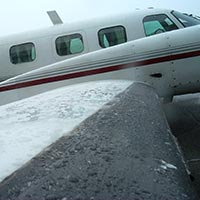
As you are conducting your preflight, you discover some loose snow and ice on the wing outboard from the engine. Another pilot tells you not to worry about those chunks, because they'll just come off during the takeoff roll. Is he right?
Situated Questions Risks
Question 4
You are flying a light twin out of a mountain airport. It is cold; during the preflight there was ice on the aircraft, but you de-iced and everything looks good. The instruments look good as you roll down the runway and rotate into IMC. During the climb out, everything appears normal but you airspeed begins to decrease. The altimeter appears frozen. What should you do?
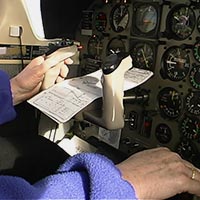
A. Pitch over. Ice has frozen on the aircraft and you are probably about to stall.
B. Fly pitch and power. The pitot heat has failed and the pitot tube is blocked.
C. Check the engine gauges. One of the engines has probably ingested a piece of ice.
D. Open the alternate static source. The static ports have probably frozen over.
Situated Questions Risks
Question 5
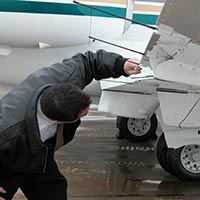
During preflight you notice your co-pilot looking at the top of the horizontal stabilizer but not bending to look under the tail. Should you ask him to go back and check the bottom of the tail?
Situated Questions Risks
Question 6
While taxiing in light rain, you notice the OAT reads 0C. Shortly after the plane lifts off, you feel the aircraft shudder without warning. Could this be an incipient wing stall?
A. No. Even if there were ice accretion on the aircraft, the stall warning would activate before the aircraft begins to stall.
B. Yes. Ice accretion could be preventing the stall warning system from operating normally.
C. Yes. Ice accretion on the wing could cause the aircraft to stall before the stall warning system activates.
D. Yes. Both B and C.