A Pilot's Guide to Ground Icing
Module IV - De-Icing Operations
How to take it off
Section: Fluid Application Tools
Start This SectionFluid Application Tools De-Icing Operations
De-icing Fluid
Whether you apply a de-icing fluid yourself, or request that the de-icing service provider (FBO) apply it with a truck, you will need to understand some essentials of the fluid de-icing process.
- Only certain fluids (Types I, II, III & IV) that have been qualified and tested for material compatibility and aerodynamic acceptance should be used on your aircraft. (See Module III: How Fluids Work)
- De-icing is accomplished primarily by the heat and hydraulic force of the spray.
- Prepare for the application, including knowing your aircraft's "no spray" zones.


Fluid Application Tools De-Icing Operations
Application Tools
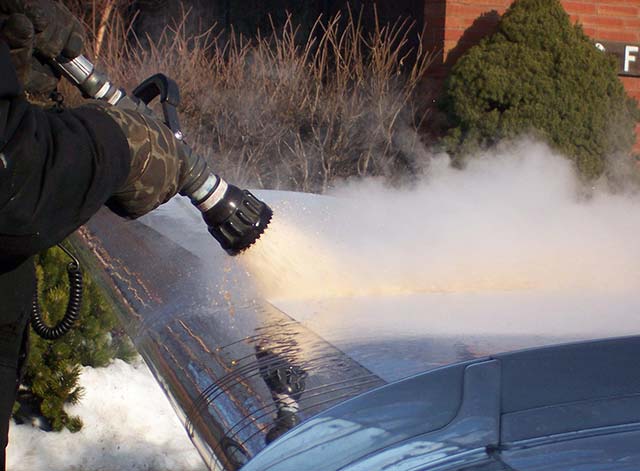
The optimum tools to apply de/anti-icing fluids depend on what is available and the size of your aircraft. Common tools include:
- Truck or cart
- Hand-held sprayer
- Mop or cloth


Fluid Application Tools De-Icing Operations
Truck or Cart
De/anti-icing trucks and carts come in a wide variety of sizes and capabilities. Most trucks have a lift to reach tail surfaces but most carts rely on ladders. So, it's a good idea to call ahead to be sure the truck or cart is operational and it has the ability to reach the tail of your aircraft. Also, some newer trucks may have heated blowers that can be used in the deicing process.
Many trucks have the ability to hold two types of fluids so be sure the correct fluid is applied to your aircraft. Trucks and carts should be properly heated to 60-80C or 140-180F for Type I fluid. Since fluid is added to the truck as it gets low there is a possibility for the fluid mixture to change over time so never assume fluid is at the appropriate mixture. In fact, if the fluid mixture has not been checked recently you may want to insist they do this prior to application to your aircraft.


Fluid Application Tools De-Icing Operations
Hand-held Sprayer
A hand-held sprayer can be an affordable and effective de-icing tool, even though you won’t get the same heat and hydraulic force as applied by a de-icing truck or cart.
Hand-held sprayers for de-icing aircraft are slightly different than those for the garden. De-icing sprayers may have an immersible heater, and may be an approved container for holding the fluid in flight. That is, it will not leak with pressure evolutions like the garden sprayer likely will. If you plan to carry a hand-held sprayer and fluid with you in the air, make sure the container for the fluid will not leak, and that all fluids are labeled properly.
Further Information
Sprayers can be purchased from a number of aviation suppliers along with de-icing fluids. Consider the following fluid issues.
Ethanol-based fluids (such as Kilfrost RDF) are...
- very flammable. Do not use in a heated sprayer.
- limited to removing thin amounts of frozen contamination.
- not portable aboard aircraft since they are considered Hazardous Material.
- not be used for anti-icing, including active frost.
Glycol-based fluids (Type I fluid) are...
- always applied heated and diluted to be safe and effective (heat is needed to melt ice).
- capable of removing larger amounts of contaminants.
- not considered Hazardous Material and can be taken aboard the aircraft (keep sealed)


A hand-held sprayer can be an effective & affordable de-icing tool
Fluid Application Tools De-Icing Operations
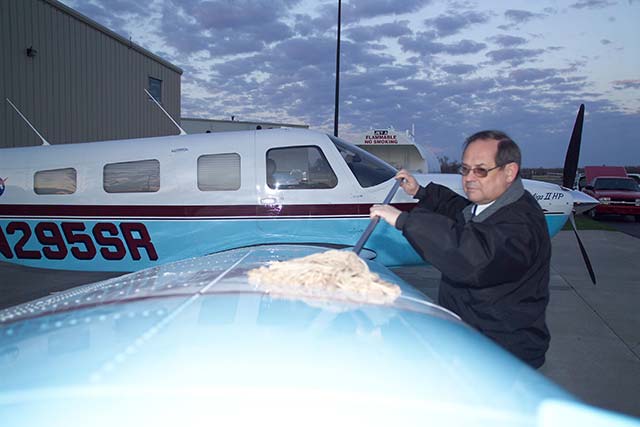
Mop or Cloth
Some pilots apply de-icing fluid with mop, brush or clean rag. These methods with finer control might be advantageous around sensors and some no spray zones, for example, using a rag to wipe the propeller clean.
Be sure to use a fluid that is approved for your aircraft. Otherwise, you risk damaging the skin, seals, etc. or having the fluid not completely shear or blow off during the takeoff roll. See Fluid Basics: How Fluids Work
