A Pilot's Guide to Ground Icing
Module IV - De-Icing Operations
How to take it off
Section: Fluid Application Procedures
Start This SectionFluid Application Procedures De-Icing Operations
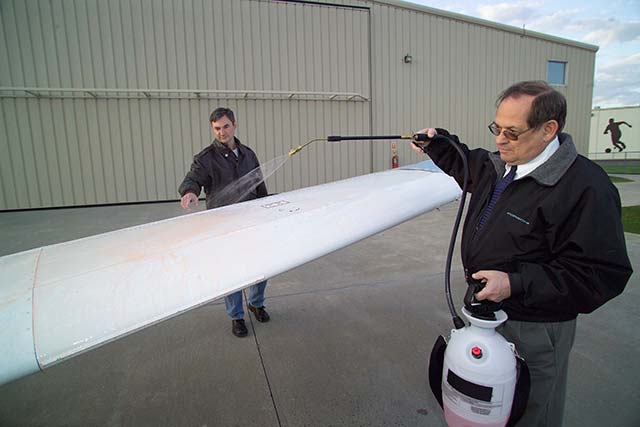
Whether you apply the fluid yourself or someone else does, it is your responsibility, as PIC, to make sure the application is done properly.
In this chapter we’ll suggest some questions to ask and best practices for de/anti-icing your aircraft. These suggestions are meant to supplement, not replace your aircraft manual(s) and/or company SOPs.

Fluid Application Procedures De-Icing Operations
In airline operations, de/anti-icing is conducted by ground crews who are trained in that company’s approved procedures and are monitored to ensure company standards.
If you do not enjoy this dedicated support, you must assess the adequacy of the de-icing services available to you, and determine if the provider (FBO) will be able to meet your requirements. Ask a few basic questions to understand whether or not the services available will meet your needs, and to gain insight on how much direct supervision of the process you should provide. If you are unfamiliar with the services offered at the airfield, inquire prior to your arrival.


Fluid Application Procedures De-Icing Operations
Ask the following questions regarding the professional application of Type I, II, III or IV fluids:
Which fluid is being applied?
Typically Type I in North America, and Type II or IV in Europe.
What is the temperature of the fluid?
Ideally 60–80C (140–180ºF) at the nozzle.
To what air temperature is the fluid effective?
In general, the de-icing service provider makes sure that the fluid freezing point (determined by the fluid strength; measured by a refractometer) is such that it will protect your aircraft for the current outside air temperature (OAT). See Fluid Freezing Point (below) for more information.
Further Information
If you apply fluid with a freezing point at or only slightly below the ambient air temperature, it may soon refreeze on your aircraft’s critical surfaces. For de-icing only (no follow-on anti-icing application), the freezing point of the fluid should be 10C below the ambient temperature when using Type I fluid, or 7C when using Type II, III or IV fluid. (These buffer ranges are reduced if immediately applying an anti-icing application. See Module V: Anti-icing Application.)
Type I fluids must be heated and diluted to be safe and effective. Most fluid manufacturers supply premixed Type I fluids with fluid to water ratios typically between 50:50 and 60:40. The dilution determines the freezing point of the fluid.
The de-icing provider should check the fluid freezing point with a refractometer on a regular basis.
If it is very cold, around -20C or below, respect the Lowest Operational Use Temperature (LOUT) of the fluid. See Module III-Fluid Basics-Cautions.
Additional questions to ask the FBO operator
If you have a particularly tall tail section, make sure the spray boom can reach that high. If not, some other method of spraying and inspecting those surfaces must be arranged (e.g., air stairs, ladder).
Where will your aircraft be positioned for de-icing?
How and when will you brief the personnel who will spray your aircraft? Is there a frequency for contacting from the cockpit? If not, arrange a face-to-face briefing.
Are the de-icing personnel familiar with the no-spray areas of your aircraft?
Will you de-ice before or after your passengers/cargo are loaded?
Who will inspect your critical surfaces to ensure they are clean? If the inspection is to be done by the ground crew, how will they communicate the results to you? How will you/ground crew inspect the tail surfaces if you have a particularly tall tail section?
How will you ensure that all personnel and equipment are clear before taxiing the airplane? Fatal accidents have resulted from pilots taxiing before all personnel and equipment were clear.
There are three general type of refractometers commonly used in de-icing:
- a refractometer which reads in refractive index
- limited to removing thin amounts of frozen contamination.
- a Brix refractometer which has a scale marked in degrees Brix
- a glycol tester which has two separate scales, one for propylene glycol based fluids, and the other for ethylene glycol based fluids. The glycol tester scale is marked in degrees F or degrees C.
Refractometers are available for purchase through the fluid manufacturer, aviation, microscope or instrument supply stores.
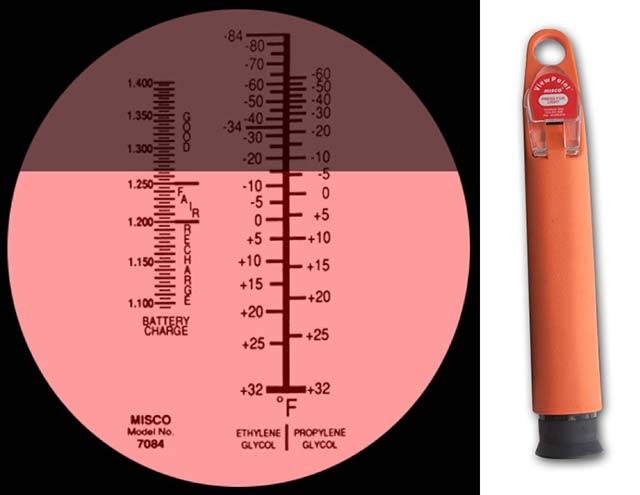
Refractometer scale (left), refractometer (right)
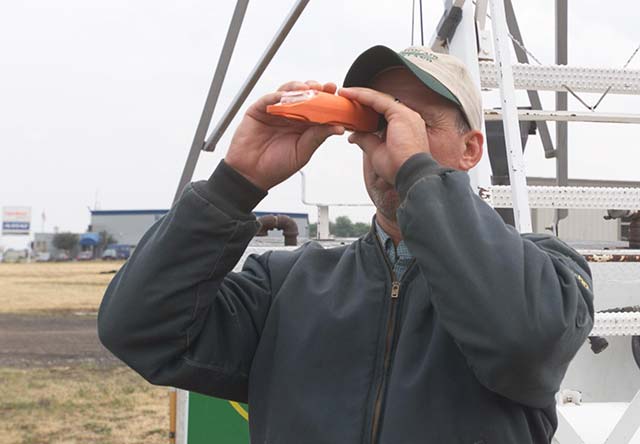
FBO operator using a refractometer
Tim Cattel - Questions to ask the de-icing service provider
Related Information
Inadequate Post Application Inspection
The Captain rendered a visual signal to ground personnel to commence de-icing as the expected clearance time approached. The de-icing crew complied and started deicing at the front of the aircraft and moved rearward. With the captain’s clearance, I walked back in to the cabin to perform a visual inspection of the wings. While I was in the cabin, the captain began to taxi. I completed my visual inspection and returned to the cockpit to inform the captains that the right wing needed more snow removal. When I contacted station personnel I was informed that the aircraft had ht the de-icing trucks cherry picker basket. Observations: 1) the station personnel's rush to get our aircraft off the gate caused poor communication resulting in a lack of coordination between the cockpit and ground personnel. 2) after de-icing started and the truck moved rearward, no ground personnel were in sight of the cockpit crew, leading to the assumption by the Captain that de-icing had been completed.
Fluid Application Tools De-Icing Operations
Prepare for the fluid application.
Whether on the ramp or at a pad, if possible, align your aircraft into the prevailing wind. This helps keep the windscreen and sensitive instruments up front clean.
Configure your aircraft according to your AFM or POH (settings for flaps, control surfaces, engine/prop, APU, etc.).


Fluid Application Procedures De-Icing Operations
De-icing applications of Type I, II, III & IV fluids should be applied heated (60 – 80 C) and close to the surface. Look for rising steam to indicate sufficient heat. The nozzle, if adjustable, should be set in the optimal way to remove the particular contamination. Type I fluids must also be diluted to the appropriate freezing point.
Ethanol-based aircraft de-icing fluids, such as Kilfrost RDF (Rapid De-icing Fluid) should NOT be heated, due to their flow flash point.
Caution
Further Information
Optimal nozzle settings for contamination types.
- Frost and Light Ice: a fan or cone spray
- Snow: a spray pattern set to flush the snow, but minimize foam production. (If contaminated with thick layer of heavy, wet snow, consider mechanical or thermal means to remove the majority of the contamination.)
- Ice: a narrow, jet-like spray pattern to penetrate the ice layer and add heat to the aircraft skin. The heat will propagate and loosen the bond of the ice. After doing this in several spots, use the hydraulic force to flush away ice. Do not overheat one spot.

Contamination removal can be optimized with different nozzle settings


Fluid Application Tools De-Icing Operations
In general, the spray should sweep from front to back, top to bottom. Certain parts of your aircraft, however, should not come in contact with fluids; others can tolerate wash-down. Check your AFM or POH for a complete list for your aircraft.
The interactive element on the next page contains a generic list of No Spray Zones that you will be able to print and take with you to share with the person de-icing your aircraft. Please adapt the hard copy so that it is in accordance with your official literature.


Related Information
NEWCASTLE, UK
DECEMBER 28, 2005
B-737
Prior to the flight the aircraft was de-iced due to snow accumulation. During a ‘No Engine Bleed Air Takeoff’, in which APU bleed air was in use, fumes and smoke entered the cockpit and cabin causing some passengers to suffer from eye and throat irritation. After isolating the APU bleed air and selecting engine bleed air the fumes dissipated. The aircraft returned to Newcastle and the passengers were offered medical attention. The fumes were as a result of de-icing fluid entering the APU air inlet during the initial climb out.
SOUTHHAMPTON AIRPORT
HAMPSHIRE, ENGLAND
DECEMBER 7, 2005
BAE-146
During pushback and the taxi for departure on the fifth sector of the day, with the auxiliary power unit (APU) bleed air source selected, the cabin crew and a number of passengers detected fumes in the cabin. Two cabin crew members experienced physiological effects. Inspection of the aircraft revealed the presence of de-icing fluid in the APU air intake. The probable cause of the incident was contamination of the cabin air supply from the ingestion of de-icing fluid into the APU compressor. The aircraft had been de-iced prior to the first sector of the day.
Fluid Application Procedures De-Icing Operations
Post Application Inspection
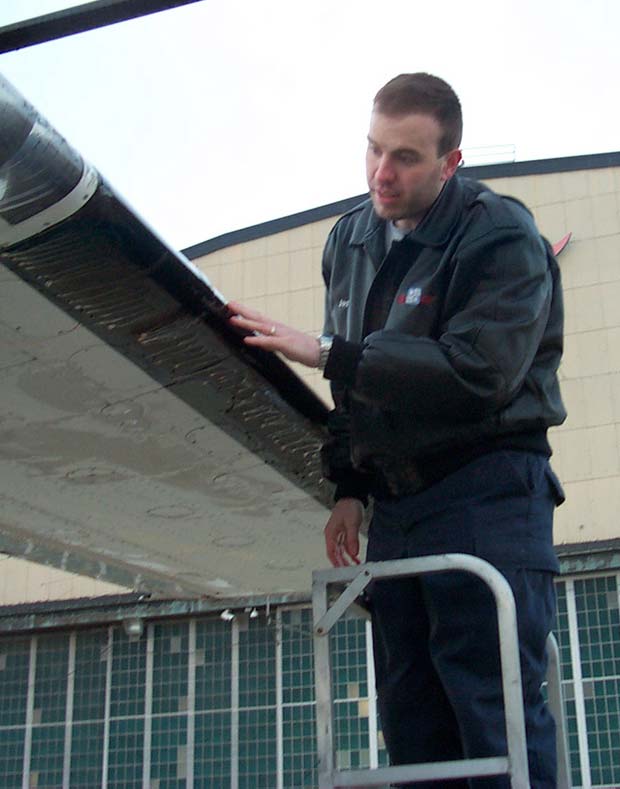
Immediately following the de-icing step, whether by mechanical means or fluids, carefully inspect the aircraft to verify that the critical surfaces are free of contamination. The best way to verify the surfaces are clean is by touch. Clear ice is almost always undetectable using visual inspection methods. Your POH or AFM might have a surface inspection checklist; a generic one is offered below.
Caution
Further Information
This generic checklist includes both critical surfaces and other surfaces that must be free of contaminants for their proper operation. A typical list includes:
- Wing leading edges, upper and lower surfaces
- High lift devices such as leading edge slats and flaps
- Spoilers and speed brakes
- All control surfaces and control balance bays
- Propellers
- Engine inlets, particle separators, and screens
- Fuselage
- Cooling and APU air intakes, inlets, and exhausts
- Landing gear
- Vertical and horizontal stabilizing devices, leading edges, upper and lower surfaces, side panels
- Windshields and other windows necessary for visibility
- Antennae
- Exposed instrumentation devices such as angle of attack vanes, pitot-static pressure probes and static ports
A tactile inspection may be required to detect residual contamination after completion of the de-icing process. Under these conditions the tactile inspection is a good procedure for the detection of clear ice on the aircraft’s critical surfaces. For some aircraft a tactile inspection may be mandatory under conditions where clear ice is likely, check your AFM for specific requirements applicable to you.
In conducting a clear ice tactile inspection, you are checking for a change in friction between your fingertips and a surface coated with de/anti-fluid over clear ice versus a surface where the de/anti-icing fluid is directly in contact with the aircraft surface. This difference in friction can be quite subtle. However with practice these subtle changes in friction can be detected quite easily, even while wearing hand protection, e.g., latex gloves.
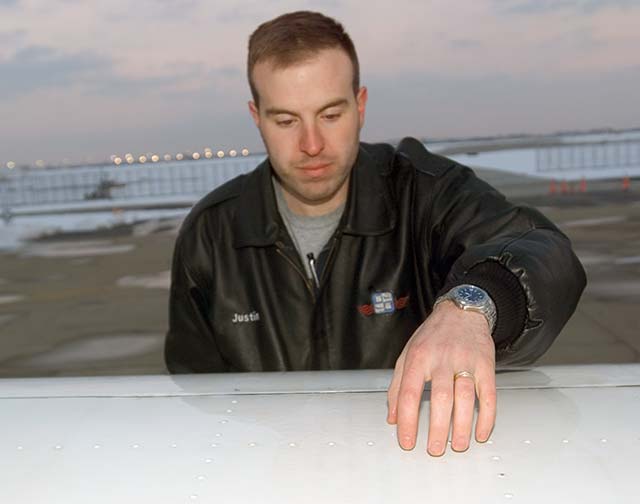
Pilot performing tactile inspection of wing
Related Information
LUBBOCK, TX – USA
JANUARY 18, 1995
C-208
During the night before the accident, freezing rain followed later by snow, fell on the ramp where the airplane was parked. A witness reported that while assisting the pilot in removing snow from the airplane, he noted that 80% of the wing was covered with a coarse layer of ice, from 1/16 to 3/16 in thickness, that was not removed before flight. After the accident, a fireman from the city of Lubbock fire department noted ice on the wing approximately 1/16th of an inch thick that had a rough texture that looked as if deposited by freezing rain. The pilot reported that shortly after take off she heard a power decrease and felt surges in the aircraft. The pilot then looked for a place to land.
A detailed examination of the engine revealed no mechanical deficiencies.
The National Transportation Safety Board determines the probable cause(s) of this accident as follows: The pilot's failure to remove ice from the airframe prior to takeoff. Factors were freezing rain the night before and the pilots' incomplete preflight inspection.
Inadequate Post Application Inspection
A de-icer checked in with me prior to deicing the aircraft and asked that I prepare for de-icing. I specifically asked that a good physical post de-icing check be performed. I was assured one would be done. I observed the deicing from an over wing exit area in the cabin. No physical post deicing check was performed. The de-icier gave a post de-icing report to my copilot, which included assurances that the wings were re-inspected and clear of ice. I talked to the de-icier on the radio. After much discussion de-icer admitted no physical post de-icing check had been performed. He said he would come back to the aircraft and perform the check. He arrived at the aircraft driving a baggage loader. He placed a ladder on the right wing and hand checked the leading edge devices. No pole check was done. He then drove the loader to the left wing, stood on the loader and did a visual check only of the left wing. He reported a proper post de-icing check completed. I asked if he had checked both wings properly with a hand check and a pole from a ladder. His reply was in the affirmative. I ordered him to the aircraft’s lower aft stairs. I proceeded the ramp and met the deicer. Again I asked him if he used the ladder and the pole to do a post deicing check. Again his reply was in the affirmative. He insisted he had. I then told him I had been watching from the cabin (along with several non-revenues) and I knew he was lying to me. Deicer then said he did not know he was required to do a physical deicing check. I ordered him to put the ladder up to the wing so I could perform a proper deicing check. He would not put the ladder up to the aircraft until I told him I would call a supervisor out to the ramp and have him removed from the ramp. At that point another man arrived at the aircraft. I believe he was the ramp supervisor. The de-icer put (the ladder) on wing while I briefed supervisor on what de-icer had and had not done. I performed the post deicing check.

